


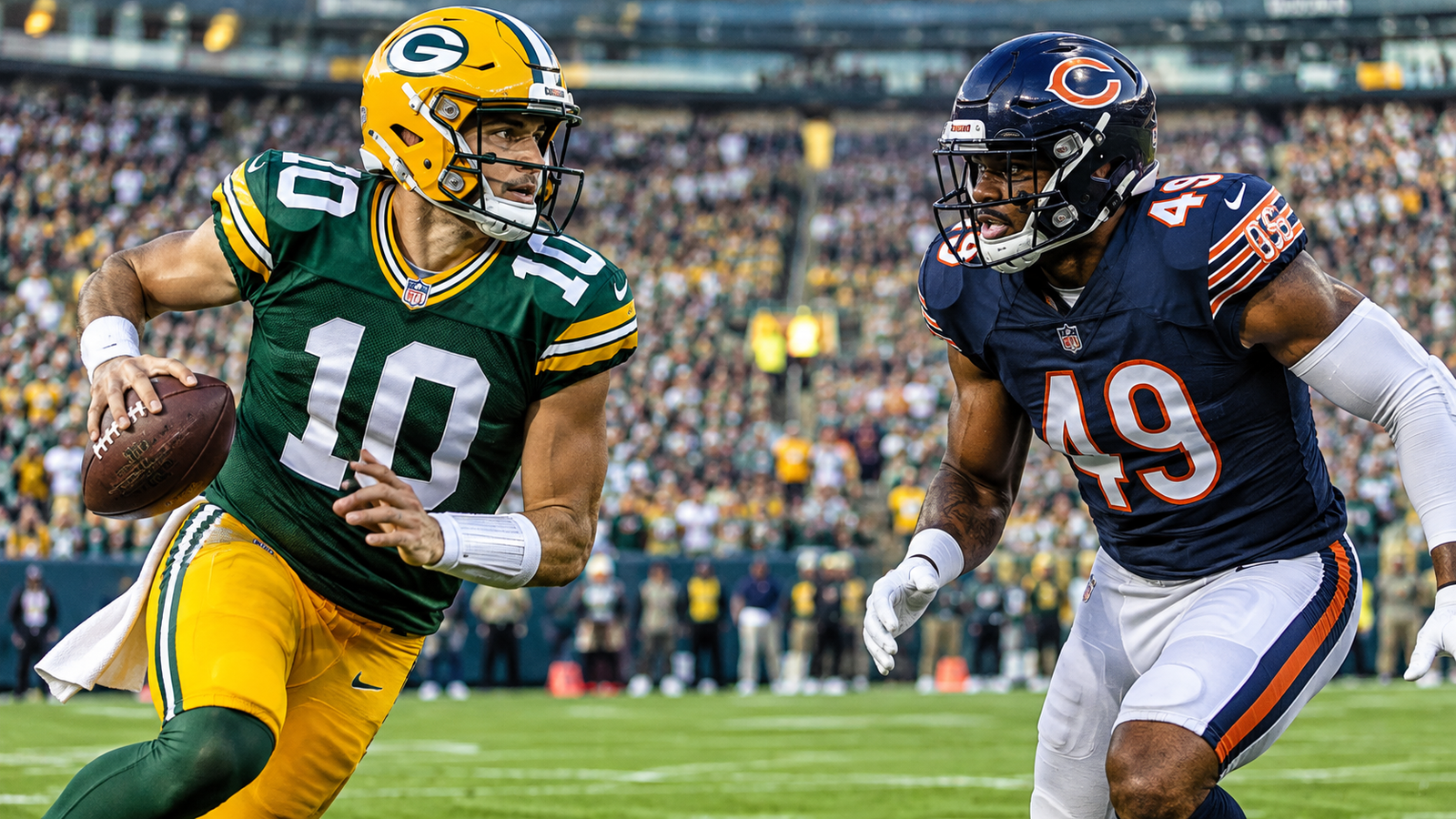
The Green Bay Packers vs Chicago Bears match player stats provide a detailed look at one of the NFL’s most historic rivalries. Their October 11, 2026, meeting at Lambeau Field ended with Green Bay securing a convincing 31–7 victory over Chicago. The Packers delivered an impressive offensive performance, recording 428 total yards compared with the Bears’ 246 yards. Quarterback Jordan Love led Green Bay’s passing attack, while Christian Watson and Matthew Golden made significant contributions through the air. Chicago struggled to establish consistent offensive momentum, and its quarterbacks faced considerable pressure throughout the contest. These statistics help explain how Green Bay controlled the game.
Green Bay Packers vs Chicago Bears Match Overview
The Packers entered the matchup looking to establish themselves against their NFC North rivals, and their performance demonstrated offensive efficiency and control. Green Bay scored 31 points, including touchdowns in the first, second, and fourth quarters, alongside additional scoring in the third quarter. Chicago managed only seven points, which came during the second quarter. The Packers finished with 428 total net yards, while the Bears recorded 246, creating a substantial difference in offensive production. Despite relatively similar possession times, Green Bay converted its opportunities more effectively. The final score reflected the Packers’ ability to sustain drives and capitalize on important scoring situations.
Jordan Love Passing Stats Against Chicago
Jordan Love delivered an outstanding performance for the Green Bay Packers, completing 25 of 31 pass attempts for 367 yards and two touchdowns without throwing an interception. His completion percentage reached approximately 80.6%, highlighting his accuracy and ability to distribute the football efficiently. Love consistently found opportunities to attack Chicago’s defense and helped Green Bay maintain offensive momentum. His passing performance was one of the most important statistical factors behind the Packers’ victory. Although Love did not contribute a passing touchdown in every scoring drive, his ability to move the ball downfield created valuable opportunities for the receiving unit and supporting offensive players.
Christian Watson and Matthew Golden Receiving Stats
Christian Watson was among Green Bay’s most productive offensive players, finishing with six receptions for 143 yards and two touchdowns. His average of approximately 23.8 yards per reception demonstrated his ability to create explosive plays. Matthew Golden also delivered a significant contribution, recording six receptions for 123 yards without a touchdown. Together, Watson and Golden accumulated 266 receiving yards, providing Jordan Love with two highly productive targets. Their performances stretched Chicago’s defensive coverage and created opportunities for the Packers to advance quickly downfield. Tucker Kraft added five receptions for 64 yards, providing another dependable option in Green Bay’s passing game.
Chicago Bears Quarterback and Passing Statistics
Chicago’s passing offense struggled to match Green Bay’s production during the matchup. Tyson Bagent completed 12 of 21 attempts for 87 yards, recording no passing touchdowns and two interceptions. Case Keenum completed 11 of 19 passes for 108 yards, also finishing without a touchdown and throwing one interception. Together, the Bears’ quarterbacks completed 23 of 40 passes for 195 yards, three interceptions, and zero passing touchdowns. These numbers illustrate the difficulties Chicago experienced moving the football through the air. Turnovers also created additional challenges for the Bears, allowing Green Bay to maintain its advantage and limit Chicago’s opportunities to make the contest competitive.
Chicago Bears Rushing and Receiving Leaders
D’Andre Swift was Chicago’s leading rushing contributor, recording nine carries for 43 yards and one touchdown. He also added four receptions for 30 yards, making him one of the Bears’ most versatile offensive players. Luther Burden III finished with four receptions for 47 yards, while Rome Odunze contributed three catches for 40 yards. Roschon Johnson recorded five receptions for 34 yards and added six rushing yards on five attempts. Although Chicago produced several individual contributions, its offensive performance lacked the explosive passing plays necessary to challenge Green Bay. The Bears’ receiving and rushing numbers show that individual efforts were not enough to overcome the team’s overall offensive limitations.
Team Statistics: Packers vs Bears
The team statistics highlight the difference between Green Bay’s offensive efficiency and Chicago’s difficulties generating production. The Packers accumulated 428 total net yards, compared with 246 for the Bears. Green Bay completed 25 passes for 367 yards, while Chicago’s quarterbacks combined for 195 passing yards. Chicago recorded three interceptions, whereas Love protected the football throughout the game. Both teams had relatively balanced possession, with Green Bay holding the ball for 30 minutes and 24 seconds and Chicago for 29 minutes and 36 seconds. This comparison demonstrates that possession alone did not determine the outcome. Green Bay made better use of its offensive opportunities and created more impactful plays.
| Statistic | Green Bay Packers | Chicago Bears |
| Final score | 31 | 7 |
| Total net yards | 428 | 246 |
| Passing yards | 367 | 195 |
| Passing touchdowns | 2 | 0 |
| Interceptions thrown | 0 | 3 |
| Time of possession | 30:24 | 29:36 |
Source: Official Packers game center and NFL game report.
Defensive Performance and Game-Changing Moments
Green Bay’s defense played an important role in securing the victory by creating turnovers and limiting Chicago’s offensive effectiveness. The Bears’ quarterbacks threw three interceptions, which disrupted their ability to sustain drives and generate scoring opportunities. Those mistakes placed additional pressure on Chicago’s offense and helped the Packers maintain control of the contest. Green Bay’s defensive players benefited from the opportunities created by the passing game’s struggles. Meanwhile, Chicago’s defense faced a difficult challenge against Jordan Love and Green Bay’s productive receiving corps. Watson’s explosive receptions and Golden’s consistent production made it harder for the Bears to prevent the Packers from advancing downfield.
You May Also Read: SPTIN
Conclusion
The Green Bay Packers vs Chicago Bears match player stats from October 11, 2026, demonstrate how Green Bay dominated the matchup through effective passing, explosive receiving plays, and strong defensive execution. Jordan Love completed 25 passes for 367 yards, while Christian Watson recorded 143 receiving yards and two touchdowns. Matthew Golden contributed another 123 receiving yards, giving the Packers multiple offensive weapons. Chicago struggled with quarterback turnovers, producing three interceptions and no passing touchdowns. Green Bay’s 428 total yards compared with Chicago’s 246 reflected the difference in offensive efficiency. Overall, the Packers’ 31–7 victory highlighted their ability to capitalize on opportunities and control a historic divisional rivalry.
Frequently Asked Questions
Who won the Green Bay Packers vs Chicago Bears game?
The Green Bay Packers defeated the Chicago Bears 31–7 on October 11, 2026, at Lambeau Field in Green Bay, Wisconsin. Green Bay controlled the game through efficient passing, productive receiving performances, and defensive turnovers. The Packers finished with 428 total net yards, while Chicago recorded 246 yards. Their offensive advantage and ability to capitalize on scoring opportunities helped Green Bay secure a convincing victory against its NFC North rival.
How many passing yards did Jordan Love record?
Jordan Love completed 25 of 31 pass attempts for 367 yards and two touchdowns against Chicago. He did not throw an interception, making his performance particularly effective. Love’s accuracy and ability to connect with Christian Watson, Matthew Golden, and Tucker Kraft helped Green Bay maintain offensive momentum. His passing production was a major factor in the Packers’ 31–7 victory.
Who was Green Bay’s leading receiver?
Christian Watson was Green Bay’s leading receiver in the matchup, recording six receptions for 143 yards and two touchdowns. Matthew Golden also performed exceptionally well, finishing with six receptions for 123 yards. Watson’s explosive receiving performance helped the Packers stretch Chicago’s defense, while Golden consistently provided another productive option for Jordan Love.
How many interceptions did the Chicago Bears throw?
Chicago’s quarterbacks combined for three interceptions during the October 11, 2026, game. Tyson Bagent threw two interceptions, while Case Keenum recorded one. These turnovers significantly affected Chicago’s offensive momentum and made it difficult for the Bears to compete against Green Bay. The Packers finished the game without throwing an interception.green bay packers vs chicago bears match player stats
