


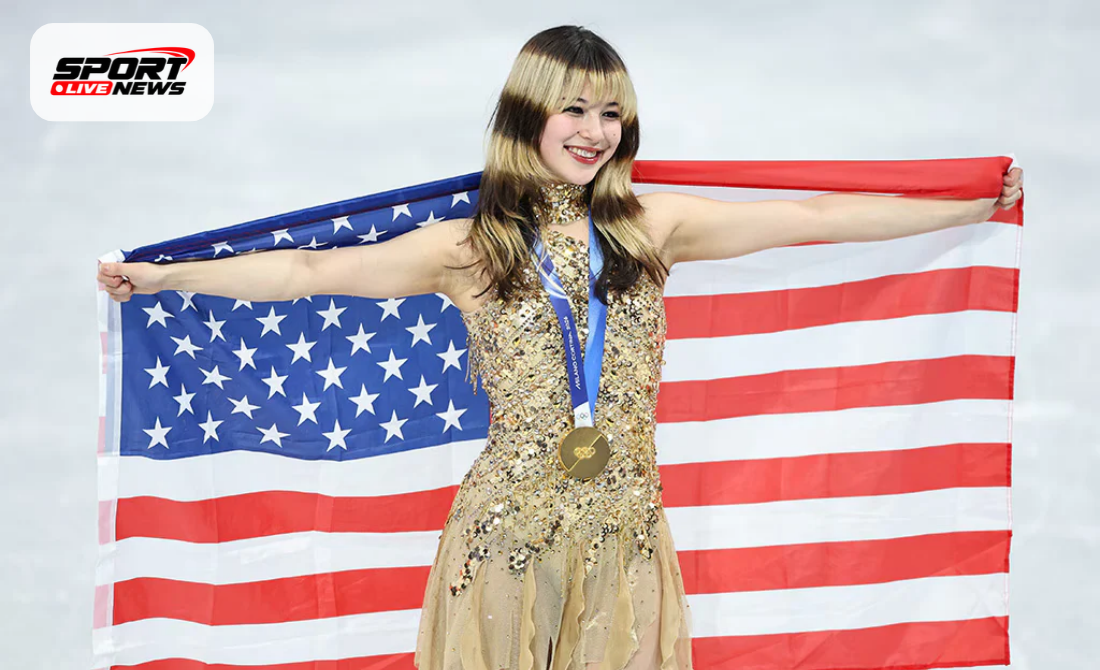
Alysa Liu won the women’s singles figure skating gold medal at the Milano Cortina Winter Olympics on February 19, 2026, scoring 226.79 points. The Alysa Liu Olympics 2026 story ended with two gold medals: the individual title and a gold from the United States’ team-event victory. Her singles win made her the first American woman to become Olympic figure skating champion since Sarah Hughes in 2002.
Instant Topic Verdict
- Individual result: Gold with 226.79 points, ahead of Japan’s Kaori Sakamoto and Ami Nakai.
- Decisive performance: A 150.20-point free skate lifted Liu from third to first.
- Olympic medal haul: Two golds, including the team event.
- Historical significance: The first U.S. women’s singles Olympic title in 24 years.
Alysa Liu’s Olympic Results: The Scores That Won Gold
Liu’s individual competition consisted of the short program on February 17 and the free skate on February 19 at Milano Ice Skating Arena. The scores from those two performances were added together to determine the medals. results.isu.org
Her results were:
- Short program: 76.59 points, third place.
- Free skate: 150.20 points, first place.
- Combined total: 226.79 points, Olympic gold.
Sakamoto finished second with 224.90, while Nakai took bronze with 219.16. Liu’s winning margin was 1.89 points, underlining how closely the title was contested.
There is an important distinction between Liu’s personal bests. Her Olympic total and individual short-program score were international career bests, but her free skate was a season best. U.S. Figure Skating lists her higher international free-skate best as 150.97 from the 2025 World Team Trophy.
How Liu Turned Third Place Into an Olympic Title
The short program kept her within reach
Nakai led after the short program with 78.71, followed by Sakamoto on 77.23 and Liu on 76.59. That left Liu only 2.12 points behind the leader and 0.64 behind Sakamoto.
Those gaps matter more than the position alone. Third place meant Liu needed to gain ground, but she remained close enough for the free skate to change the order substantially.
Her eventual 2.53-point advantage over Sakamoto in the free skate erased the short-program deficit and produced the final 1.89-point winning margin. The gold came from the combined competition, not simply from winning its closing segment.
Her technical score made the difference
Liu’s free skate earned 77.74 technical points and 72.46 program-component points, with no deductions. Technical marks reward executed elements; components assess composition, presentation and skating skills.
Sakamoto received higher component marks, 74.84, but her technical score was 72.83. Liu’s 4.91-point technical advantage therefore outweighed Sakamoto’s 2.38-point component advantage. This was a victory built on the scoring value of the completed program as well as its presentation.
Two particularly valuable elements were Liu’s triple Lutz–triple toe loop combination, worth 11.53 points, and her later triple Lutz–double Axel–double toe loop sequence, worth 12.98. Her step sequence also achieved Level 4, the highest difficulty level available for that element.
Strong execution did not mean an unmarked technical sheet
Liu completed seven triple jumps, but describing the performance as technically perfect would overlook the judges’ protocol. Both triple flips received unclear-edge warnings, although every element still received a positive overall grade of execution—the adjustment reflecting how well it was performed.
That distinction strengthens the analysis: Liu did not need an entirely unmarked score sheet. She needed enough difficulty, execution quality and presentation across the full program to outscore her rivals.
Where Sakamoto and Nakai Lost Ground

Sakamoto’s costly moment came on her second triple flip. The ISU reported that an unstable landing prevented her from adding the planned triple toe loop to the combination. She scored 147.67 in the free skate and remained second overall.
Nakai, skating last, completed a triple Axel but later doubled a planned triple toe loop in combination and stepped out of the landing. Her 140.45 placed ninth in the free skate, although her strong short program helped her retain bronze.
The competitive lesson is that one difficult jump cannot settle an entire event. Nakai’s triple Axel remained an achievement, but the cumulative scoring across both programs determined the podium.
What Music Did Alysa Liu Skate To?
Liu’s short program used “Promise” by Laufey, while her gold-medal free skate used “MacArthur Park” by Donna Summer.
The ISU’s competition report highlighted the free skate’s seven triples alongside its spins, footwork and audience response. Those details help explain why the performance resonated beyond the final score: it combined demanding skating with a clearly expressed musical identity.
How She Also Won Team Gold
Liu’s contribution to the team event came in the women’s short program on February 6. She scored 74.90 and finished second behind Sakamoto, earning nine placement points for the United States.
The distinction between the two scoring systems is useful. Her 74.90 was the score for that skate; nine points represented its contribution to the team standings. The team event combined performances across disciplines, rather than adding her individual-event total to a national score.
U.S. Figure Skating records Liu as both the 2026 Olympic women’s champion and an Olympic team-event gold medalist.
Why Her Olympic Comeback Matters

Liu retired from competition in 2022 and returned in 2024. By the time she reached Milan, she had already won the 2025 world title and the 2025 Grand Prix Final, establishing that her comeback could produce victories at the highest level.
Her Olympic success also ended two different American droughts. Hughes had been the previous U.S. women’s singles Olympic champion in 2002; Sasha Cohen’s silver in 2006 had been the country’s most recent Olympic medal in the event. Liu therefore ended a 24-year wait for gold and a 20-year wait for any medal.
Those milestones should not obscure the immediate sporting achievement. Liu entered the free skate behind two Japanese contenders and delivered the highest-scoring performance of the segment when it mattered.
FAQs
Q1. How old was Alysa Liu when she won Olympic gold?
Liu was 20 during the February 2026 Olympics. She was born on August 8, 2005.
Q2. Did Alysa Liu perform a quadruple jump in her Olympic gold-medal free skate?
No. Her women’s singles free-skate protocol lists triple and double jumps, with neither a quadruple jump nor a triple Axel.
Q3. Had Alysa Liu competed at the Olympics before 2026?
Yes. Milano Cortina was her second Olympics, following Beijing 2022. U.S. Figure Skating lists her 2022 individual finish as sixth.
Conclusion
Liu’s two Olympic golds were the headline, but the individual title’s foundation was measurable: a manageable short-program deficit, valuable combinations and a technical advantage over her closest rival.
For readers following her next chapter, Reuters reported on October 21, 2026, that Liu would sit out the new season. The next development to watch is a confirmed competitive return, rather than assuming an immediate title defence or another scheduled appearance. reuters.com
